
The Question That Was Always There
How the tradition moved the most urgent question in Christian life from the center to the margins — and what it cost.

Last week I told you where I am standing while I write this.
Severance. MCL in progress. Thirty years inside the systems I have been critiquing, followed by a forced exit at the precise moment I was preparing to choose one. I named the four figures who keep returning as I try to think honestly about what faithful response looks like — Basil, Francis, Day, Teresa — and I tried to account for my own position in relation to them.
This week I want to go back further. Not to the present moment, but to the question that has been displaced — the one this project is attempting to recover.
Because before we can name what has been lost, we need to understand what it was.
***
Imagine a community in which the following sentence is not a provocation but a description of ordinary economic reality:
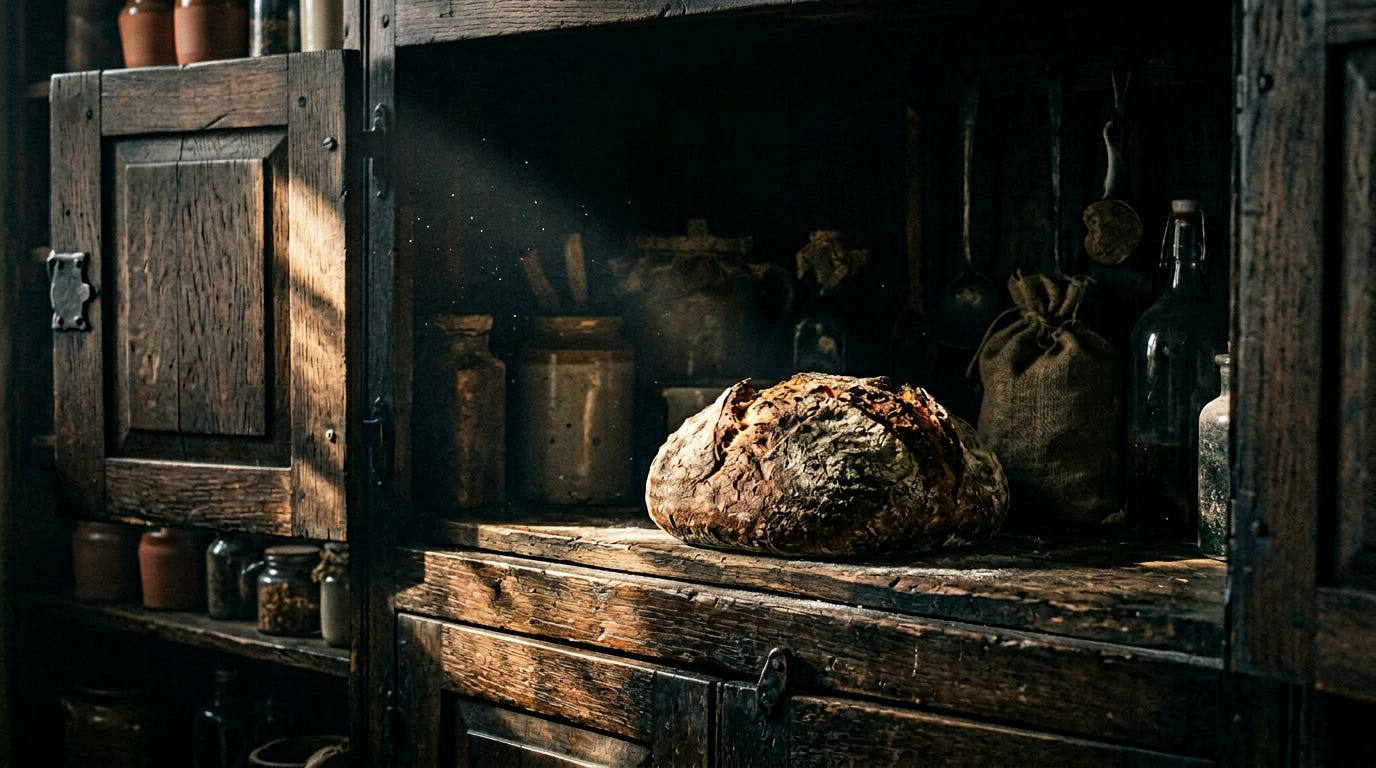
The bread in your cupboard belongs to the hungry.
This is not a metaphor. This is not a counsel of generosity. This is how Basil of Caesarea, writing in the fourth century to wealthy members of his congregation in Caesarea Mazaca, described the relationship between surplus and need. The bread you have accumulated beyond your immediate need does not belong to you. It belongs, already, to the person who is hungry. Your act of giving is not charity. It is restitution — the return of what was never rightfully yours to keep.
This is a claim about ownership. About the nature of property itself. About what it means to hold wealth in a world where others are without.
It is also a claim that has not disappeared from the Christian tradition. It is still there, in the social encyclicals, in the liberation theologies, in the prophetic strands of Protestant social witness. But something has happened to it over seventeen centuries. It has moved. Not gone — moved. From the center of Christian moral life to its margins. From a claim that disrupts the entire structure of life to a consideration that can be acknowledged without generating the disruption that once made it unavoidable.
This movement is what The Moral Hinge is about.
***
The movement did not happen through malice. It happened through formation.
Charles Taylor’s account of the transition from the porous self to the buffered self — from the medieval person whose identity was constituted by embeddedness in community, cosmos, and God, to the modern person whose identity is secured within an interior domain largely insulated from external claims — describes one dimension of this formation. The buffered self can affirm Basil’s claim about the bread in the cupboard without being disrupted by it, because the self is experienced as separable from the claim. Belief is held. The claim is acknowledged. And life continues largely undisturbed, because the gap between belief and practice has become, over centuries of gradual formation, normal.
But the formation is older than Taylor’s account of modernity, and it runs through the specific history of the Christian tradition itself.
The Constantinian settlement of the fourth century — the recognition of Christianity by the Roman Empire — made the Church an institutional actor within the economic arrangements it had previously stood apart from. The bishops who had been countercultural voices became managers of imperial patronage. The communities whose economic practices had been organized around mutual obligation became communities whose economic practices were increasingly organized around the norms of the surrounding culture.
This is not a conspiracy. It is an accommodation. And accommodations happen through the slow accumulation of reasonable decisions — each one defensible in its immediate context, each one slightly loosening the purchase of the tradition’s most demanding claims on the actual lives of the people making the decisions.
***
What was the question that was always there — the one that got moved?
It was the question Basil asked directly, and that the tradition has been learning to ask more quietly ever since:
What do I owe the person who has less than I do?
Not: what am I willing to give? Not: what is an appropriate level of charitable contribution? Not: what can I afford to donate while maintaining my current standard of living?
What do I owe?
The distinction between owing and giving is the entire argument of this project in miniature. Giving assumes the giver’s ownership of the surplus. The giver has something, decides what portion to share, and retains the rest as legitimately theirs. The transaction is voluntary, which is to say the giver retains authority over whether it happens.
Owing assumes something different. It assumes that the surplus was never solely the owner’s to begin with — that wealth is held in trust for a community, that the accumulation of resources beyond one’s needs generates an obligation that does not depend on the accumulator’s willingness to acknowledge it. The transaction is not voluntary in the same sense. It is the return of what was always owed.
Basil understood wealth as owed. The contemporary church, with some significant exceptions, understands wealth as available for giving. That movement — from owing to giving, from obligation to generosity, from restitution to charity — is the displacement this project has been tracing.
***
The displacement did not happen because Christians became worse people. It happened because the institutional arrangements within which Christians lived their faith gradually made the question of what is owed harder to ask and easier to defer.
When the Church became an economic actor — owning land, receiving bequests, managing endowments, depending on the generosity of the wealthy for its institutional survival — it acquired a structural interest in not pressing the question of what the wealthy owed too aggressively. The bishop who needed the donor’s patronage could not afford to tell him that the bread in his cupboard was not his.
This is not hypocrisy in the simple sense. It is the structural condition of an institution that must sustain itself within the arrangements it is called to challenge. And it is a condition that has been deepening for seventeen centuries.
***
The question that was always there is not gone. It has been displaced — to the margins, to the exceptional individual, to the rare community that has not made the accommodation. The rural congregation that stayed when every other institution left is asking it, because the circumstances of its survival require it. The immigrant congregation practicing mutual obligation as a condition of communal survival is answering it, because it never had the luxury of the alternative.
And occasionally, someone in a comfortable suburban church hears a sermon, or reads a paragraph of Basil, or walks past a Shady Grove Motel where someone has been tending plants outside their door — and the question surfaces again, briefly, before the next obligation arrives and the moment passes.
This project is an attempt to hold the moment open long enough for the question to press on the whole structure of life.
Not because guilt is the point. But because clarity is the precondition of faithful response. And the tradition has always insisted that you cannot respond faithfully to a question you have learned not to ask.
The bread in your cupboard belongs to the hungry.
It was true in the fourth century. It is true today. The question is whether we have enough silence left to hear it.
I hear it. I feel guilt. I confess I feel safer as a giver.