

This series has spent considerable time on diagnosis.
The displacement of the question of what we owe. The transition from the porous self to the buffered self. The ledger replacing the face. The charitable economy as a technology for managing distance. The communal body as the tradition’s alternative to managed giving.
This week I want to be concrete. Not programmatic — I am not proposing a seven-step plan for recovering the porous commons. But specific about what the communities that never fully made the accommodation actually do, in their ordinary life together, that constitutes the witness I have been describing.
Because the argument is only as useful as its ability to illuminate something recognizable. And the practices I am about to describe are recognizable — either because you have encountered them in communities different from your own, or because you have a distant memory of something like them, or because you have a sense of their absence that you have not quite been able to name.
***
The first practice is knowing names and situations without a database.
In the communities that practice genuine mutual obligation — the immigrant congregation, the rural church that stayed, the urban community rooted in shared poverty — people know what is happening in each other’s lives not because there is a pastoral care tracking system but because they talk to each other. Regularly, informally, in the normal texture of shared life.
This sounds simple. It is not. It requires a density of contact that most contemporary communities have lost — the frequency of encounter that comes from sharing not just a weekly gathering but an ongoing daily or weekly proximity to each other’s actual lives. The neighbor you see at the mailbox. The fellow congregant you run into at the grocery store. The community whose rhythms of life are interwoven enough that the knowledge of what someone is going through arises naturally rather than through a formal system designed to surface it.
When this density of contact exists, the response to need is also natural. You do not need a formal request process or a benevolence fund application. Someone mentions they are struggling and someone else responds — because the relationship already exists, because the knowledge is already shared, because the obligation arises from the membership itself rather than from a programmatic structure designed to route need to resources.
***
The second practice is showing up before being asked.
This is perhaps the single most distinctive feature of communities organized around genuine mutual obligation, and the one most thoroughly eliminated by the charitable economy’s model of need assessment and resource allocation.
In the communities I am describing, people show up. Not because they received a notification from a care coordination system, but because they knew — from the density of contact described above — that someone was in a situation that warranted presence. And they came. With food, with time, with their bodies in the room, before anyone had formally identified the need or requested a response.
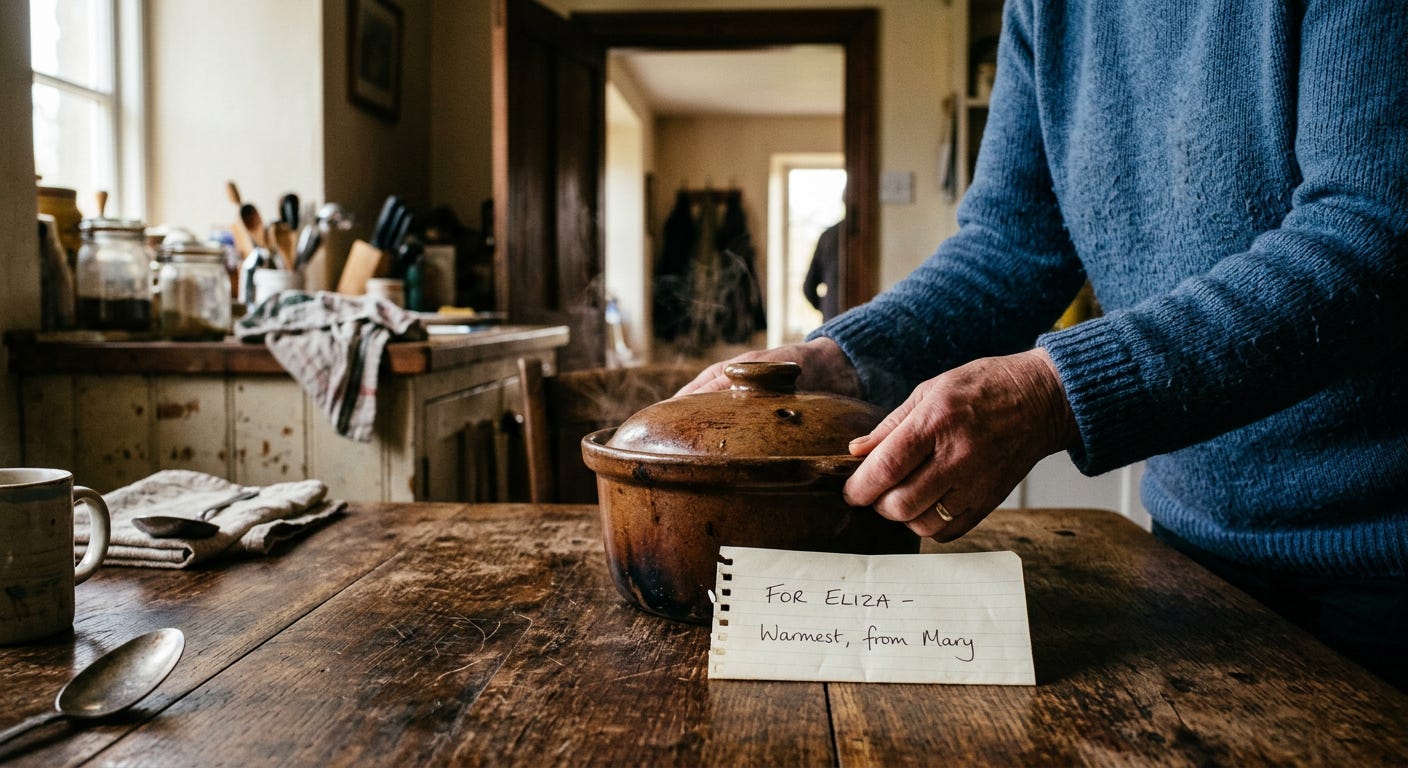
This is what Taylor Adams described in his response to last week’s post — the experience of growing up in a community where knowing someone and being tied to them economically were not separate categories. The showing up before being asked is the economic expression of a prior bond. It is the porous commons enacted in a casserole dish and a Wednesday afternoon.
The contrast with the managed distance of the charitable economy could not be sharper. The charitable economy requires a need to be formally identified, assessed, and matched to an available resource through an institutional intermediary. The community practicing genuine mutual obligation requires only that someone notice and respond. The institution absorbs the encounter in one model. In the other, the encounter is the point.
***
The third practice is staying through the long season.
Need, in the real lives of real people, is rarely acute and brief. It is more often chronic and slow — the kind that does not resolve in the timeframe of a benevolence fund grant or a meal train or a GoFundMe campaign. The person who is sick for months. The family navigating a long financial crisis. The elderly person whose isolation deepens gradually rather than arriving all at once.
The communities I am describing stay. Not because they have a program for long-term pastoral care — though some of them do — but because the membership of the community includes the person in the long season, and membership is not time-limited.
This is one of the places where the contrast with the managed-distance model is most stark. The charitable economy is organized around acute need and defined interventions. It is much better at responding to a crisis than at accompanying someone through a season. The institution that addresses the acute need has done its job; the ongoing need is someone else’s department, or no one’s department, or the individual’s responsibility to navigate alone.
The community that stays has not done its job when the crisis passes. Its job is to be the community — which is an ongoing vocation, not a completed intervention.
***
The fourth practice is sharing resources without a transaction.
This is the most economically distinctive practice, and the one that most directly recovers what the earliest Christian communities were doing when they held things in common.
In the communities I am describing, resources move between members not primarily through formal giving processes but through the ordinary texture of relationship. The person with a truck helps someone move. The person with a skill fixes something for someone who cannot afford to hire it done. The person with surplus food brings it to the person who is short. The person with time sits with the person who is lonely.
None of these are charitable donations. They are not tax-deductible. They do not appear in any benevolence budget. They are the ordinary expressions of membership in a community where common life is the ground of obligation — where the resources you have are understood, at some functional level, as available to the community rather than exclusively to yourself.
This is not communism. People in these communities own things, have savings, make economic decisions primarily in their own household’s interest. But the boundary between what is mine and what is available to my neighbor is more permeable than the buffered economy encourages — and that permeability is practiced, sustained, and transmitted to the next generation not through doctrine but through the ordinary texture of shared life.
***
None of these practices requires a program. None of them requires an institutional structure, a budget line, or a formal process. They require only the density of shared life that makes them natural — the frequency of contact, the depth of mutual knowledge, the commitment to remaining in community through difficulty, and the prior understanding that membership generates obligation.
This is what has been lost, and what the diagnosis of managed distance has been pointing toward. Not the absence of charitable programs — there are more of those than ever. But the absence of the shared life that makes the practices described above arise naturally rather than needing to be engineered.
The question for the communities reading this Substack — the communities that have the resources to maintain the managed distance — is whether they are willing to pursue the density of shared life that would make these practices possible. Not as a program. Not as an initiative. But as a choice to arrange their common life differently — to be, in the specific conditions of their particular place, more like the communities that could not afford the alternative.
I do not know what that looks like in your specific community. I am still working out what it looks like in mine.
But I am increasingly convinced that the working out has to happen in community — with the people who are also asking the question, in the specific geography where the question has a concrete answer.
That is where we are going next.
***
Next week: The geography of obligation — why place matters to the tradition’s economic ethics, and what it means to be rooted.
You are definitely clear! "None of these practices requires a program. None of them requires an institutional structure, a budget line, or a formal process. They require only the density of shared life that makes them natural — the frequency of contact, the depth of mutual knowledge, the commitment to remaining in community through difficulty, and the prior understanding that membership generates obligation."