

Last week I wrote about the difference between the distance we manage and the distance we close. A reader’s challenge since then has been pressing me to ask: where are the communities that never had the distance to manage in the first place?
# # #
A pastor I respect wrote to me after a recent post.
He did not disagree with the argument. He complicated it — which, as any honest writer will tell you, is considerably more useful than disagreement.
The diagnosis I have been developing across this Substack — that the Christian tradition has progressively insulated economic obligation from the full weight of the Gospel’s demands, producing a buffered self capable of affirming the tradition’s most radical claims without being disrupted by them — assumed, he pointed out, a particular kind of church. The church I am writing from. The church I am writing about.
Which is not the only church there is.
# # #
The Berber communities of North Africa in the fourth century did not have the option of the buffered self.
This is one of W. H. C. Frend’s central insights in his foundational study of the Donatist movement — the controversy that pitted Augustine’s theology of grace against the Donatist insistence that the Church must be visibly holy. Frend argued that the theological dispute sat atop deep socioeconomic fault lines. The Donatists were rooted in rural peasant communities whose identity had been formed under imperial pressure. The Catholic episcopate was concentrated in the Romanized urban centers whose accommodation to that pressure the Donatist communities were, in part, protesting.
For those communities, the question of whether the Church’s life matched its claims was not an academic question. It was the question. The bishop who had handed over the scriptures to save his own position had not merely failed ethically. He had disclosed, through the doing, what he actually was. And the community whose sacramental life depended on his integrity felt that disclosure in the most concrete possible terms.
This is the porous self that Charles Taylor describes — the self for whom the boundary between spiritual and social reality is not a boundary at all. You could not be a member of that Church and be insulated from your neighbor’s suffering, because the Church and the neighbor and the suffering were woven from the same fabric.
# # #
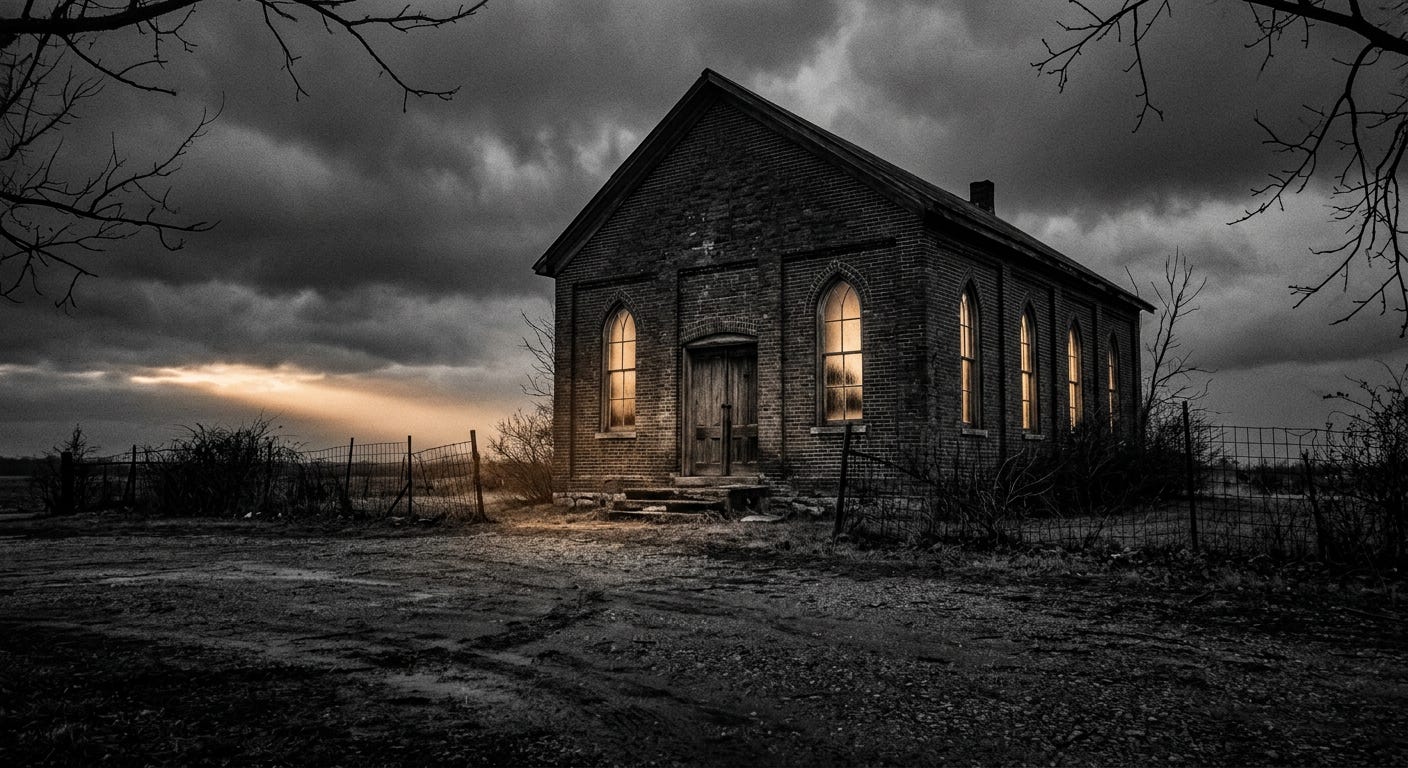
The rural congregation in a county that has lost its hospital, its school, and its grocery store is not practicing presence as a spiritual discipline.
It is practicing it as the only thing left to do.
When every other institution has calculated that the return on investment does not justify staying, the church that remains is not making a theological statement. It is simply there. And being there — week after week, season after season, for people who have no other place to bring what they are carrying — is, it turns out, the most theologically precise act available.
The immigrant congregation meeting in a borrowed space, whose members work the jobs the buffered economy has decided are essential but not adequately compensable, is not recovering the porous commons as a project. It inhabits it because its life together does not permit the distance that the porous commons refuses. These communities are not the patient the book is diagnosing.
In many cases, they are the cure.
# # #
This changes the posture the book must adopt — and that this Substack must adopt alongside it.
The argument that the Christian tradition has accommodated economic inequality across seventeen centuries is accurate for the tradition it describes. It is not a universal diagnosis. The global church, the majority-world church, the communities formed in poverty and sustained by presence — these have not made the accommodation in the same way or to the same degree. Their witness is not a footnote to the argument. It is the argument’s destination.
Basil of Caesarea built the Basileias from a position of relative privilege — he had an inheritance to liquidate. Dorothy Day opened the door from a position of deliberate poverty — she chose it. But the rural congregation that stayed when everything else left, the immigrant community that never had the option of the managed distance — these communities did not choose their witness in the same way. It was given by circumstance. And circumstance, it turns out, can produce the same theological result as intentional faithfulness: a community that looks different from the surrounding culture because it has no choice but to be different.
# # #
The tradition’s most demanding economic claims have not disappeared from the earth.
They have been displaced, in the Western church, from the center to the margins. But at the margins, they persist.
And the church that wants to recover what it has lost could do considerably worse than to look, with genuine humility, at the communities it has most consistently overlooked — not to study them, not to program them, not to send them resources from a safe distance, but to receive from them the witness they have been offering, mostly without an audience, for a very long time.
The church that stayed has something to say to the church that managed its departure.
The question is whether we are quiet enough to hear it.
Peter Hamm served as Chief Clerk of the Committee on Rules of the United States House of Representatives and spent twenty years in corporate leadership. He is pursuing a Master of Christian Leadership at Leland Theological Seminary, with a vocational horizon in hospice chaplaincy and care ministry. He is completing a book, The Moral Hinge, on the history of Christian economic accommodation. He writes at themoralhinge.substack.com.