

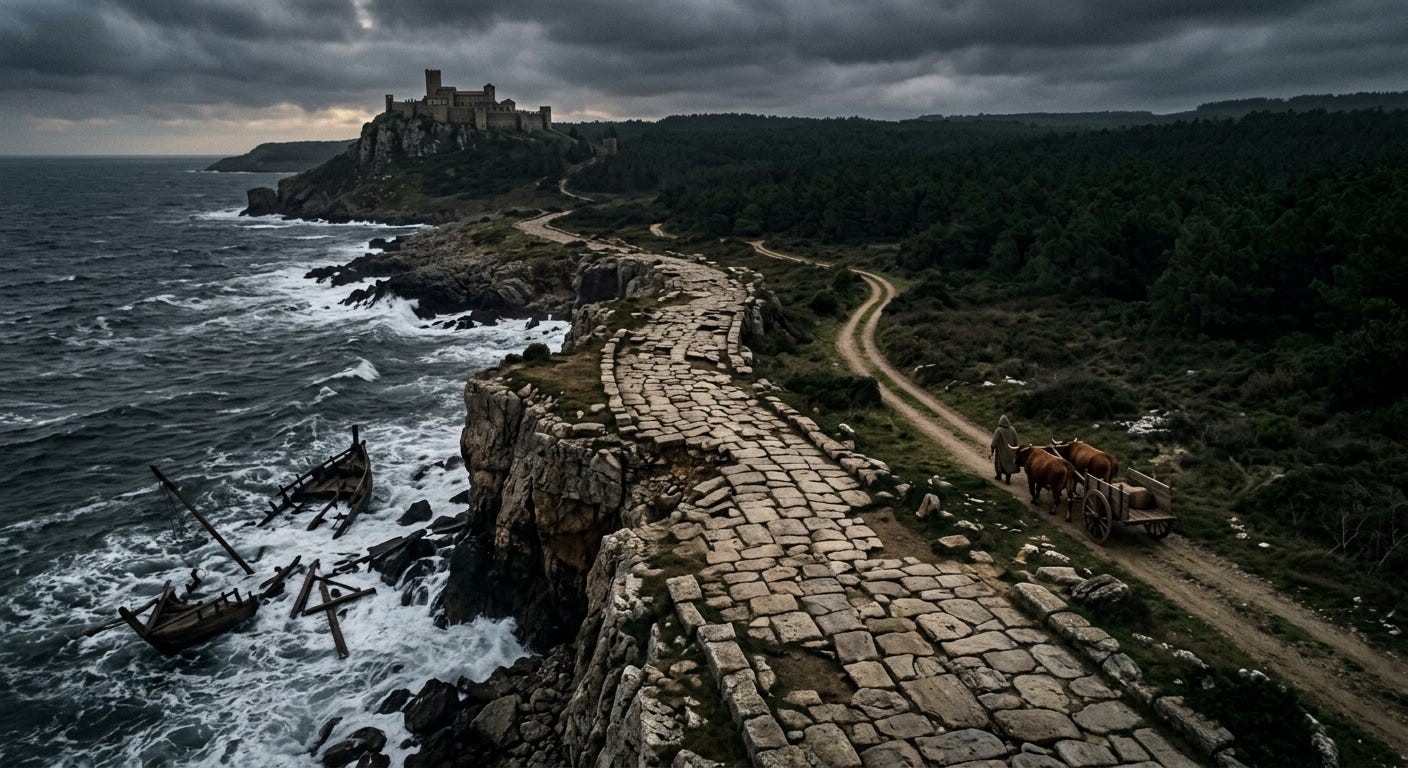
If wealth is a “braided river” and the self is “porous,” the Imperial Hinge is the story of the literal ground shifting beneath the feet of the West.
In the early 20th century, the historian Henri Pirenne proposed a thesis that still haunts our understanding of the Middle Ages. He argued that the Roman world didn’t “fall” in the 5th century due to barbarians; it stayed Roman in its bones—trading, eating, and communicating across a unified Mediterranean—until the 8th century.
Then, the hinge swung shut.
The rise of the Carolingians and the shifting geopolitical tides in the East effectively “broke” the Mediterranean highway.
The Result: No more papyrus for records. No more spices for the table. No more gold for the currency.
The Consequence: The West was forced to turn inland. The economy shifted from the “sea and trade” to the “land and the plow.”
Why this mattered for the Church:
When the state’s secular infrastructure collapsed because the “highway” was gone, the Church was the only entity with the literacy, the land, and the “ledger” to keep society from starving. The Imperial Hinge didn’t just change the map; it turned the Church into the West’s primary economic engine.
As we prepare for our April 14th deep dive, keep this image of the “Broken Highway” in mind. It was out of this physical isolation that the modern “Managerial Machine” was born.
The hinge is squeaking and swaying once again, broken and decades away from repair of infrastructure, literacy, and changes in currency.